
An original Umanifest exploration for a fictional brand. The imagery is illustrative, and the story describes a possible website approach.
- Focus
- Construction & custom homes
- Project type
- Fictional brand exploration
A construction website with room for the work.
Stonehaven explores a particular kind of building-business presentation: confident, spacious, and grounded in the visual quality of architecture. It is an imagined brand, created to demonstrate an approach. The home image is original illustrative imagery and does not represent a Stonehaven commission or a project completed by Umanifest.
The exercise asks how a website could connect a strong first image with useful business information. For an actual builder, that information would include the work accepted, the company’s approach, its real projects, and the way a prospective customer begins a conversation. Those details would give the visual direction its purpose.
Build the opening around one expressive image.
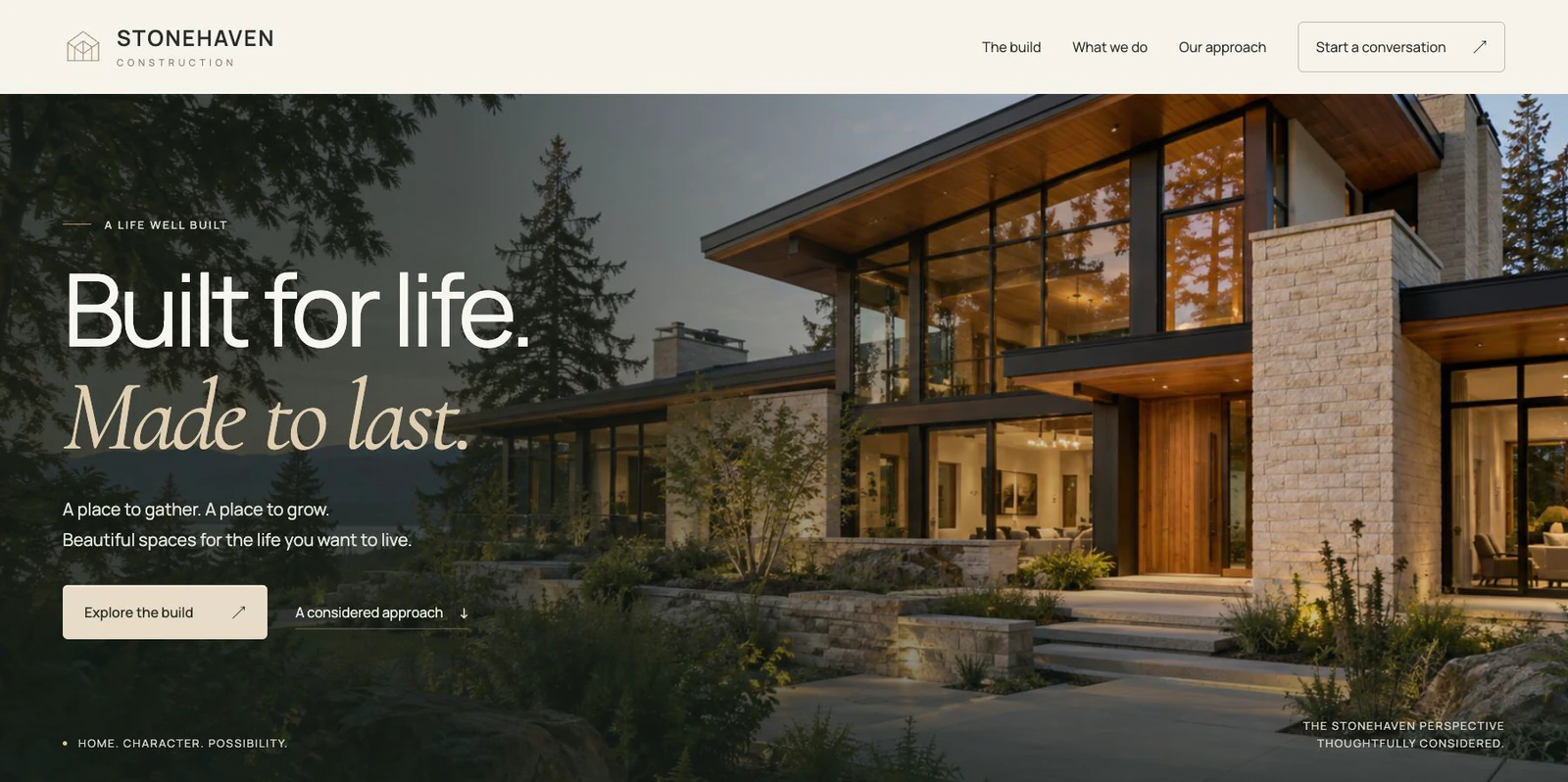
The hero photograph gives the building a strong presence while leaving darker landscape space for the headline. Limestone, cedar, glass, and evening light set a warm architectural tone. Large type and restrained supporting copy share that image without turning the first view into a collection of competing panels.
Warm ivory and charcoal continue through the layout, with a serif and sans-serif mix providing both expression and readable detail. Fine divisions and generous spacing suggest care in the composition. The aim is to make the opening memorable while leaving the rest of the page ready to explain the work.
Turn a first impression into a project story.
A future customer usually needs more than an architectural photograph. They need to recognize whether the builder handles the kind of work they are considering and understand what an initial conversation involves. The demonstration therefore includes project, service, and approach sections, with navigation leading to those parts of the page.
In a client project, a gallery could connect real photographs with the brief, the builder’s role, and the details that matter to the customer. A project story can then lead naturally toward services and contact. This approach makes space for the work without asking visual atmosphere to replace practical information.
Compose the phone view around the same priorities.
Architectural images often have a wide composition. A phone crop needs to preserve both the important part of the building and enough contrast for nearby text. The demonstration adjusts its layout at narrow widths rather than simply compressing the desktop arrangement into a smaller frame.
Navigation, headline wrapping, and the sequence of content are part of that work. A real builder website would also review the project information and inquiry route at phone widths. A person should be able to find the type of work, service area, and next step without needing the large-screen composition to understand the page.
Let craft include the way the page is used.
The demonstration uses working section links, an accessible mobile menu, and subtle image movement. Reduced-motion preferences keep the content visible without the decorative movement. The site has no real commercial inquiry submission, business address, or invented project testimonial.
The portfolio screenshot and the demonstration photography use local responsive image assets. Appropriate image dimensions, descriptive text, readable body copy, and visible keyboard focus all support a considered presentation. They belong alongside visual polish, while any complete accessibility or performance assessment would require the final business content and a defined testing scope.
Keep the architecture and the business connected.
Stonehaven’s central idea is a website that gives architectural imagery the space it deserves while continuing into an understandable business story. The image, type, and sequence of sections work together instead of treating the hero as an isolated design exercise.
A similar commissioned website would begin with genuine project photographs, the owner’s services, and the customers they want to reach. Those facts can support an individual visual direction. Stonehaven is a way to discuss that possibility and identify which parts of the visual rhythm, story, and customer journey might suit a real business.
TAKE A CLOSER LOOK
Explore the demonstration.
The full example lets you explore its composition and interactions. Your own website would use your business information, content, and customer process.